Best performance
85% single-pass CO₂ conversion at 1 kWh(el.AC)/kg syngas.
refuel.green turns renewable H₂ and captured CO₂ into FT-, methanol- and DRI-ready green syngas — modular, catalyst-free and engineered for industrial economics.
Own a defensible technology position in a critical PtX process step — with capital-light scaling and strategic M&A optionality.
Investment thesis →Integrate a standardized syngas module instead of developing the RWGS core from scratch.
Integration path →Enable scalable e-SAF and DRI projects with a flexible, low-carbon syngas supply.
Application value →Fischer-Tropsch e-fuels and e-methanol need a reliable source of syngas from renewable hydrogen and captured CO₂. Today, this conversion step is still a major technical and economic bottleneck.
RWGS+ is designed to close that gap with a highly modular microwave-plasma process that can sit between hydrogen/CO₂ supply and downstream synthesis.
The development of our innovative technology for a sustainable future is financially supported by the European Union. As part of the funded project, we aim to make an important contribution to the defossilization of industry.
In detail: refuel.green is developing a microwave-plasma reactor that converts CO₂ into green carbon monoxide (CO), an important chemical feedstock, while simultaneously treating industrial wastewater wherever possible. This innovative process enables the climate-neutral use of CO₂ as a resource, reduces greenhouse-gas emissions and breaks down contaminants in the supplied wastewater at the same time. The technology combines a simple modular design with low operating pressures and requires no catalysts, which both reduces costs and enables operation in a range of industrial applications.
The project’s objectives go beyond technical innovation: refuel.green aims to create an economically viable alternative to fossil-based processes and thereby transform the chemical industry, aviation and other hard-to-electrify sectors sustainably. The work focuses in particular on increasing the chemical conversion of CO₂ and improving electrical energy efficiency, as these are the key indicators for realizing an economically competitive product.
Implementing the project will enable refuel.green to advance its technologies to a higher technical level and prepare for market entry. With the planned market launch of modular reactors by 2029, refuel.green will play a key role in the transformation toward a CO₂-neutral industry.
This groundbreaking technology exemplifies Saxony’s innovative strength and demonstrates how companies can contribute through research and development both to achieving climate targets and to strengthening the region’s economy.
The RWGS+ architecture targets high conversion, low complexity, modular scaling and flexible syngas production — without a catalyst dependency.
85% single-pass CO₂ conversion at 1 kWh(el.AC)/kg syngas.
Simplified high-temperature process and standardized hardware architecture.
Operating strategy can respond to electricity, feedstock and market price fluctuations within seconds.
Scale by adding standardized modules instead of redesigning the core process.
H₂:CO from 1:1 to above 2:1 for different downstream pathways.
Designed to accept recycled FT tail gas without separate pre-reforming.
Zero catalyst-related CAPEX, maintenance and replacement exposure.
Designed for low soot formation and reduced metal dusting risk.
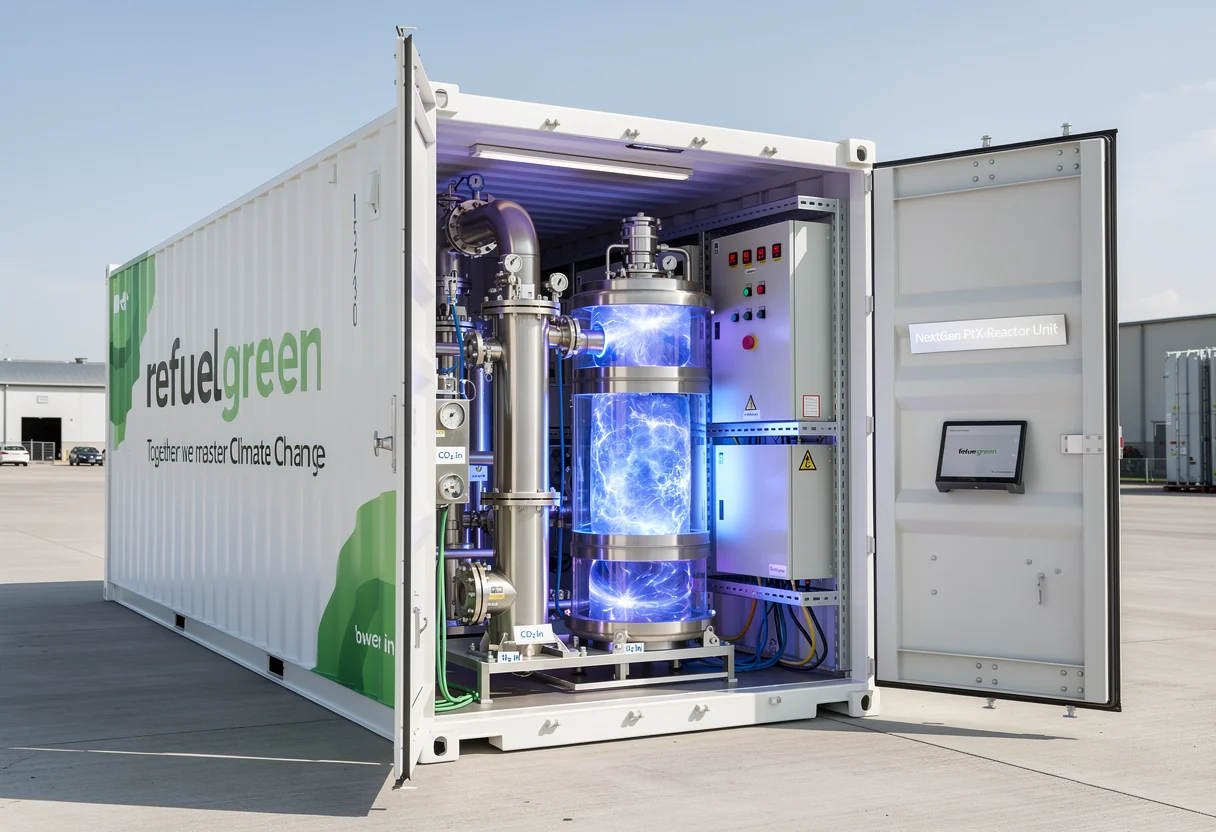
The technology is embodied in standardized 1 MW, 40-foot container modules designed to give EPC partners a repeatable building block for e-fuel & DRI plants.
✓Commercial off-the-shelf microwave generators
✓Standardized interface for EPC-led plant integration
✓Parallel modular scaling from prototype to commercial plant
Based on refuel.green's calculations, RWGS+ targets materially lower syngas cost than state-of-the-art RWGS, co-SOEC and microwave-plasma routes.
Pitch-deck calculation basis: €0.05/kWh electricity · €2.5/kg H₂ · €150/t CO₂ · H₂:CO = 1.8:1. Target values, not guarantees.
EPC partners bring global project execution and customer access; refuel.green provides the core technology at very low CAPEX.
RWGS+ is positioned upstream of several large PtX value chains, creating strategic relevance beyond one single end product.
FT-ready syngas for synthetic aviation fuel projects facing rising SAF demand and quota pressure.
Flexible H₂:CO ratios support methanol-oriented PtX pathways and maritime decarbonization.
A non-fossil syngas route for chemical intermediates and drop-in production pathways.
Potential reducing gas for direct reduced iron (DRI), combining H₂ and CO in a configurable feed.
RWGS+ can use captured CO₂ from steelmaking with renewable H₂ to generate an H₂/CO mixture for a suitable DRI process.
Hydrogen supports fast ore reduction; CO also acts as a reducing agent and can contribute carbon to the iron. Unlike pure-H₂ operation, a mixed gas offers another lever for the furnace heat balance and DRI carbon content.
Gas purification, H₂ availability, the optimum H₂:CO ratio, carbon deposition, CO₂ balance and the DRI furnace design must be validated for each project. Direct use of untreated steelworks off-gas is not assumed.
Technical context: DLR, Carburization in direct reduction (2026).
Contact us to discuss your requirements with our specialist →EU frameworks include RED III, the RFNBO rules and ReFuelEU Aviation. In parallel, South Korea has introduced a CCUS legal framework, recognizes renewable synthetic fuels in petroleum law, and has announced SAF blending obligations.
The Act on Carbon Dioxide Capture, Transport, Storage and Utilization took effect on 7 February 2025.
Official source ↗Since 7 August 2024, petroleum-alternative-fuel law has included renewable synthetic fuels made from hydrogen and renewable carbon.
Official source ↗The Korean government’s 2025 roadmap provides for 1% SAF blending from 2027 for fuel supplied to international flights departing Korea; this is not an e-SAF-specific quota.
Official source ↗Regulatory snapshot: November 2026. Final project eligibility depends on applicable law, fuel certification, lifecycle emissions and implementation rules.
For a strategic investor, the value is not only the module business. It is access to a differentiated syngas technology that can strengthen an existing e-fuels, methanol, DRI, EPC or industrial-gas portfolio.
Defensible technologyIP strategy targets key conversion, energy, catalyst-free and flexibility advantages.
Strategic fitComplementary to FT, methanol, DRI, hydrogen, CO₂ capture and EPC portfolios.
Multiple revenue streamsEquipment, licensing, engineering and recurring royalties.
M&A optionalityA strategic partner can secure access early and retain a path toward deeper integration.
TRL 4 achieved
TRL 5 target
TRL 6 target
TRL 7 target
1 MW demonstration / pre-series possible with committed demo partners, a site and financing.
100 kW in 2028, followed by 1 MW in 2029, subject to accelerated engineering and validation.
Welcomes refuel.green's technology and supports its validation and scale-up.
Prepared to contribute engineering support.
Would like to explore the possibility of collaborating on demonstration projects.
The core team combines hands-on technology development with PtX industry access and investor-facing execution – and is ready to scale as needed with identified experts.

Technology & Product

Product-Market-Fit

Finance & Investor Relations
Whether you are evaluating a strategic investment, an EPC integration or a future e-SAF / DRI project, we would like to discuss where RWGS+ fits your value chain.